
Rayleigh–Taylor
Buoyancy-driven instability in the Boussinesq approximation: a cold, dense layer sits above a hot, light one, and the interface rolls up into the classic mushroom plume. The system couples momentum, continuity, and temperature transport for
Results
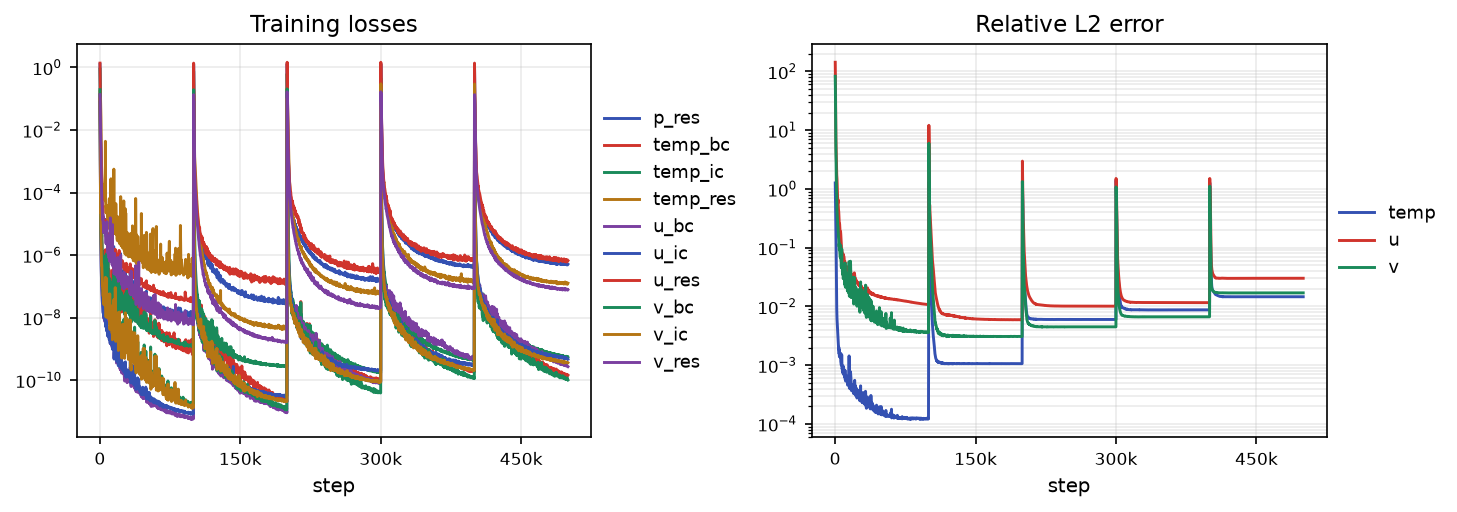
The starkest baseline-vs-pseudo-time contrast in the suite. Trained plainly, the network never leaves the quiescent state — the velocity errors sit at 0.99 for the entire run while the residual loss happily decreases: a textbook spurious solution, since "nothing moves" nearly satisfies the equations early on. With adaptive pseudo-time stepping and five time windows, the instability develops correctly and the entire trajectory — from the first interface perturbation through the fully developed plume — is captured to a stitched temperature error of 8.3e-03 (u: 0.030, v: 0.017): the mushroom cap, stem roll-ups, and side vortices are all quantitatively right, with the error confined to the thin thermal filaments. Notably, each window trains from a fresh initialization (transfer_learning=False): warm-starting a window from the previous window's parameters traps the optimizer and the same run diverges to O(1) velocity errors.
Run
cd examples/rayleigh_taylor
python3 main.py --config=configs/pseudo_time.py \
    --config.time_range="(0.0, 9.75)" \
    --config.training.num_time_windows=5 \
--config.training.transfer_learning=False| Config | Description |
|---|---|
configs/baseline.py | PirateNet + causal weighting |
configs/pseudo_time.py | Adaptive pseudo-time stepping (showcase) |
configs/fixed_pseudo_time.py | Constant pseudo-time weights |
Notes
- Four residual components keyed by variable (
u,v,p,temp), each with its own adaptive loss and pseudo-time weight — see the variable-keyed residual convention. - Boundary conditions flow through the batch via a dedicated
BCSampler(top/bottom walls at every step).