
Kuramoto–Sivashinsky
Spatiotemporal chaos with fourth-order hyper-diffusion:
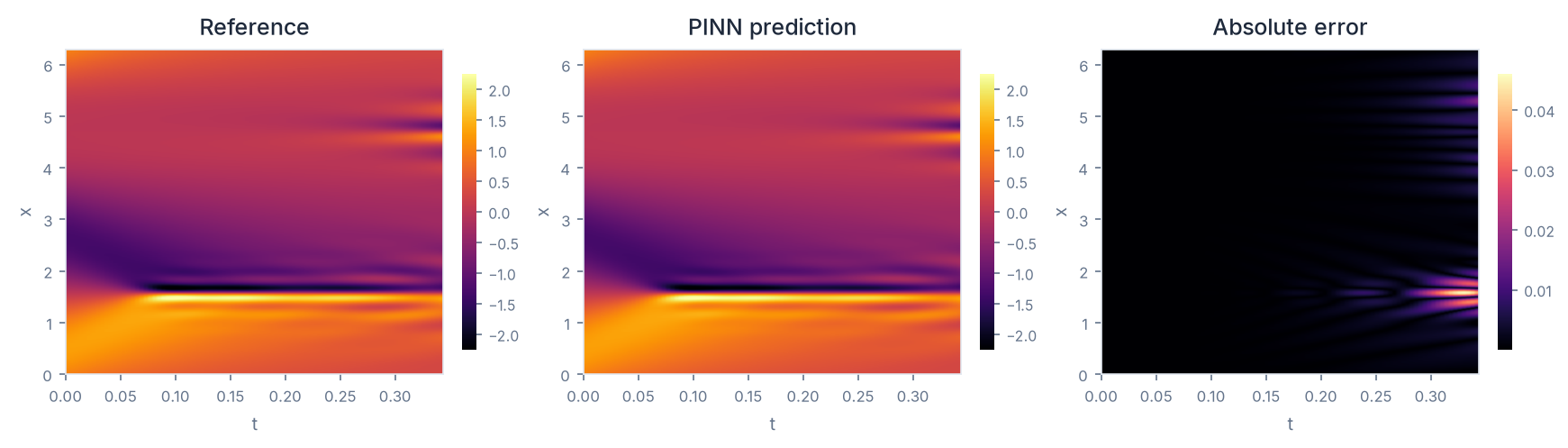
with periodic boundaries, trained through the transition to chaos.
Results
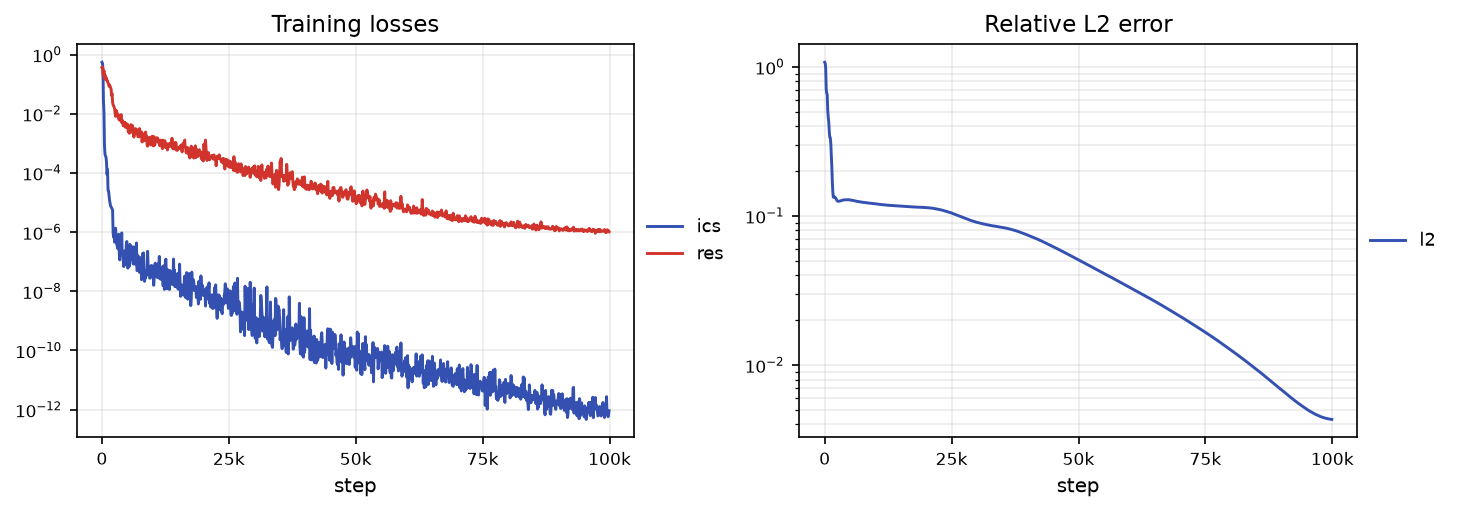
The chaotic trajectory is tracked to a relative L2 error of 4.3e-03 — and here pseudo-time stepping is transformative, cutting the baseline's 9.4e-02 by 22×. As the dynamics transition to chaos, the plain residual loss develops transient minima that pull training off the trajectory; the damping term suppresses exactly those excursions. Two further observations sharpen the picture: with pseudo-time active, causal weighting becomes redundant (turning it off even edges slightly ahead at 3.6e-03), and a parameter-matched comparison of PirateNet, ModifiedMlp, and a plain MLP shows all three tie at the baseline level — the method, not the network, is what moves this benchmark.
Run
cd examples/ks
python3 main.py --config=configs/pseudo_time.py| Config | Description |
|---|---|
configs/baseline.py | PirateNet + causal weighting |
configs/pseudo_time.py | Adaptive pseudo-time stepping (showcase) |
configs/fixed_pseudo_time.py | Constant pseudo-time weights |
Notes
- Longer horizons use time-window training (
--config.training.num_time_windows=4), propagating the network's own prediction as the next initial condition. - Fourth derivatives via Taylor-mode AD (
jax.experimental.jet).