
Allen–Cahn
Phase separation with a stiff double-well reaction term:
with periodic boundary conditions and
Results
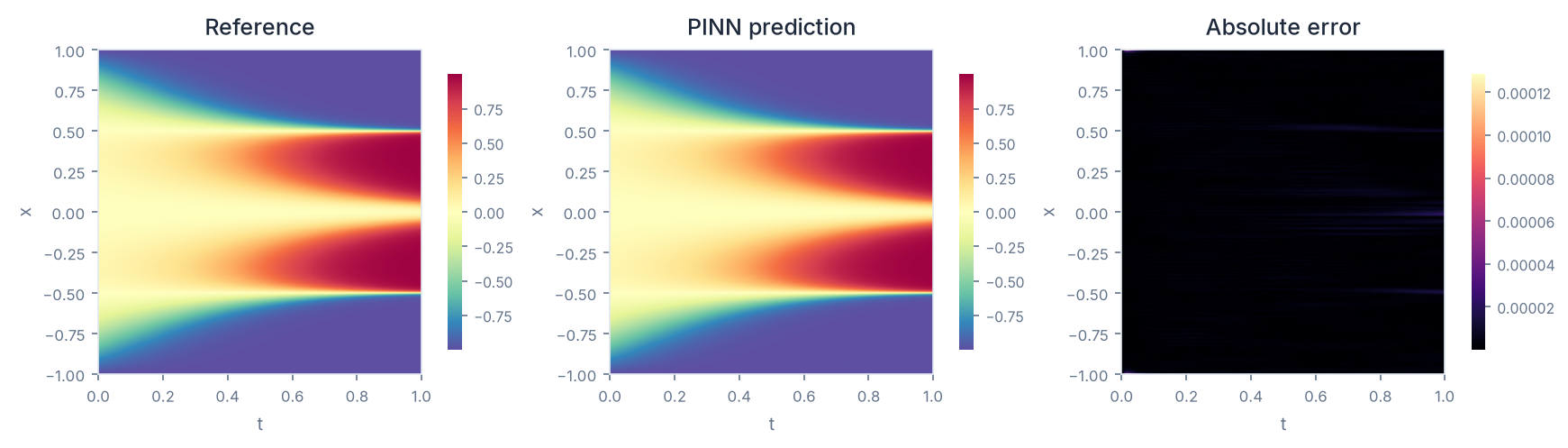
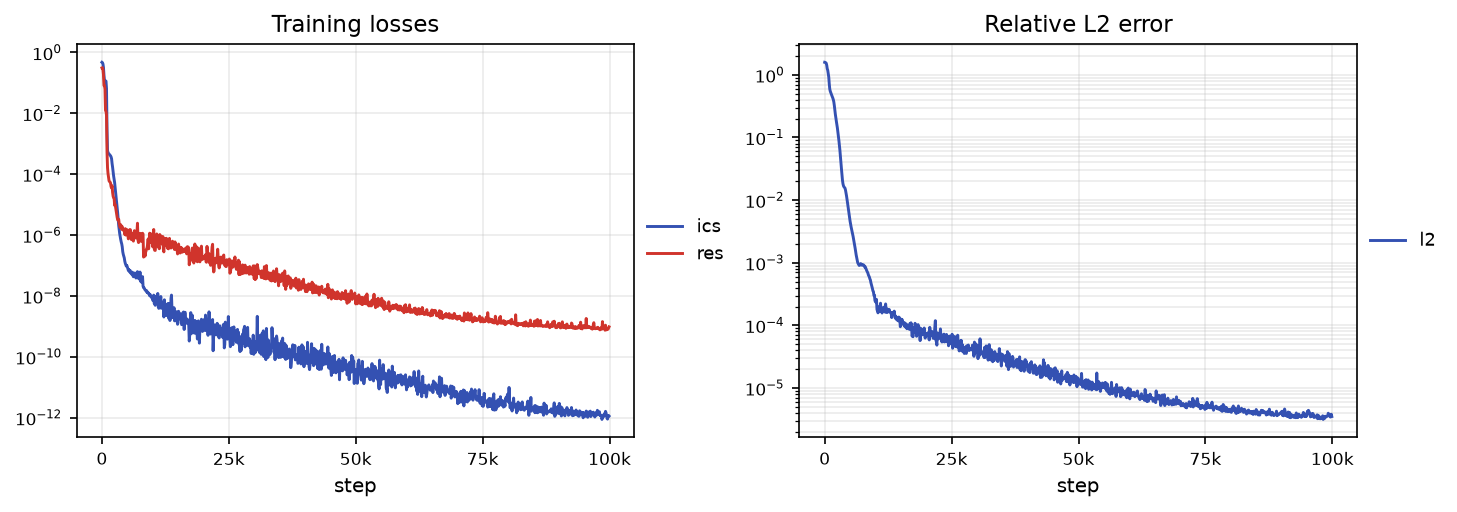
The standard JAXPI recipe solves Allen–Cahn to machine-practical accuracy: the trained network matches the reference to a relative L2 error of 4.0e-06, with the absolute error concentrated in thin bands around the transition layers and three orders of magnitude below the solution scale. Historically this benchmark is where PINNs collapse to the trivial equilibrium without causal weighting; interestingly, our experiments show the modern stack is so robust here that disabling causal weighting barely matters (4.6e-06) — the remaining ingredients compensate. Adaptive pseudo-time stepping is equally harmless (4.1e-06) but unnecessary.
Run
cd examples/allen_cahn
python3 main.py --config=configs/baseline.py| Config | Description |
|---|---|
configs/baseline.py | PirateNet + causal weighting |
configs/pseudo_time.py | Adaptive pseudo-time stepping |
configs/fixed_pseudo_time.py | Constant pseudo-time weights |
Notes
- The standard testbed for the causal loss — see the causal training deep-dive.