
Advection
1D linear transport of a periodic profile at high speed — the classic sanity check for causal PINN training, since the solution must propagate strictly forward in time:
with periodic boundary conditions and
Results
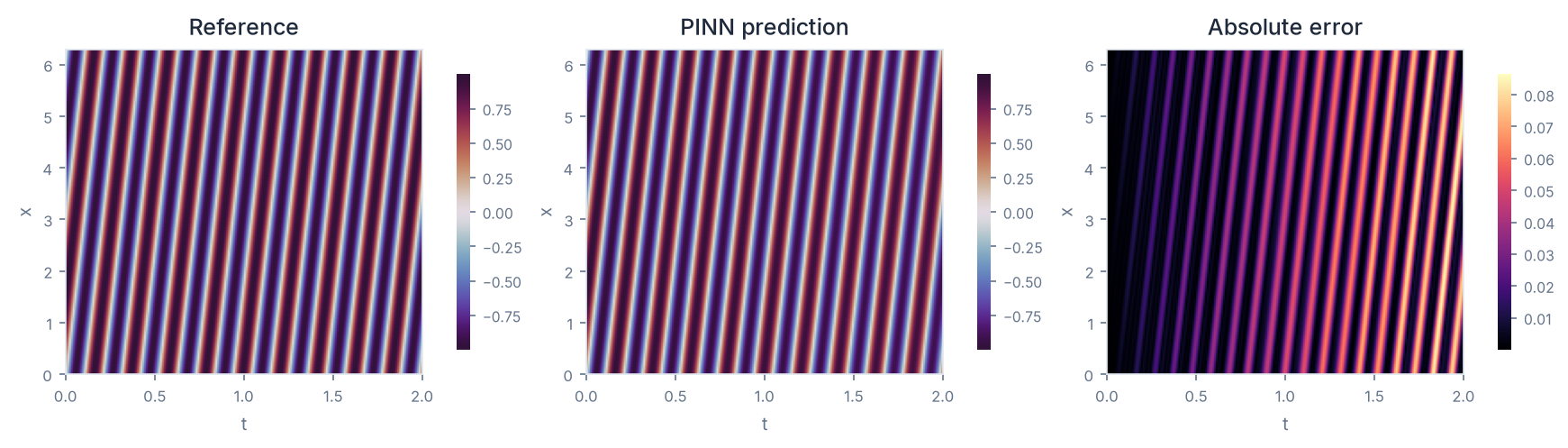
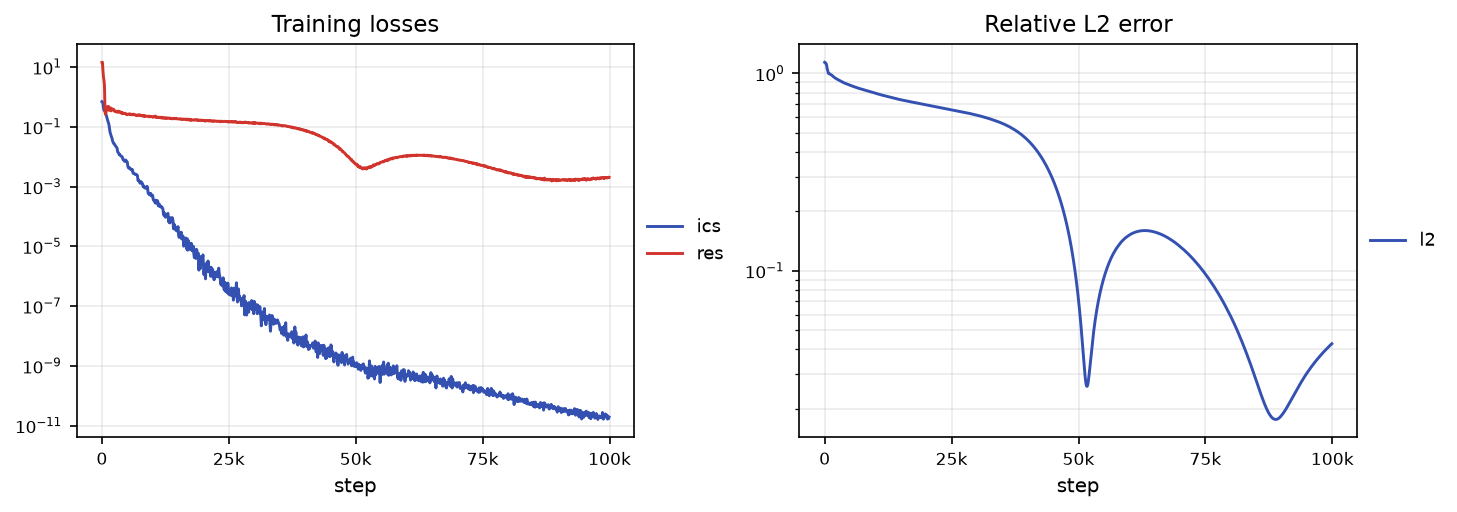
Fast transport turns out to hinge on one hyperparameter: the causal tolerance. With the default tol = 1.0, the large residuals of high-speed advection drive every causal gate to zero — only the earliest sliver of time ever trains, the initial condition is fit perfectly, and the rest of the domain is garbage (relative L2 error stuck at ~0.8-0.9 across every architecture and embedding we tried). Relaxing the tolerance to tol = 0.01 (now the config default, with 32 chunks) lets the causal front actually sweep the domain and the same network reaches 4.3e-02, with the error growing gently along the transport direction. A cautionary counterexample: increasing the Fourier embedding scale to "help" the fast dynamics made things worse (0.38) — the fix was in the training schedule, not the representation.
Run
cd examples/advection
python3 main.py --config=configs/baseline.py| Config | Description |
|---|---|
configs/baseline.py | PirateNet + causal weighting |
configs/plain.py | Minimal MLP + Adam, no bells and whistles |
configs/pseudo_time.py | Adaptive pseudo-time stepping |
configs/fixed_pseudo_time.py | Constant pseudo-time weights |
Notes
- Exact periodicity is enforced through
PeriodEmbson the spatial axis, so no boundary loss is needed. - The high advection speed makes plain PINN training collapse to trivial solutions; causal weighting fixes this (see Training Techniques).
- The advection speed is configurable:
--config.problem.c=....